Field work / carcere minorile Rome
/1
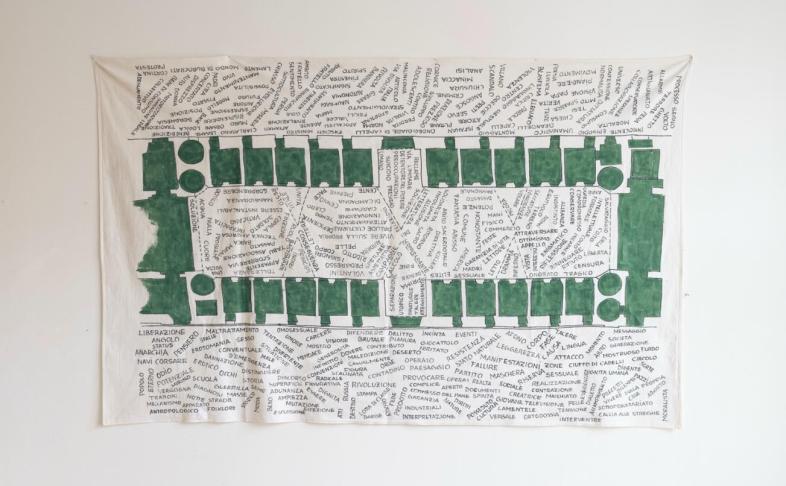
- Field work / carcere minorile Rome
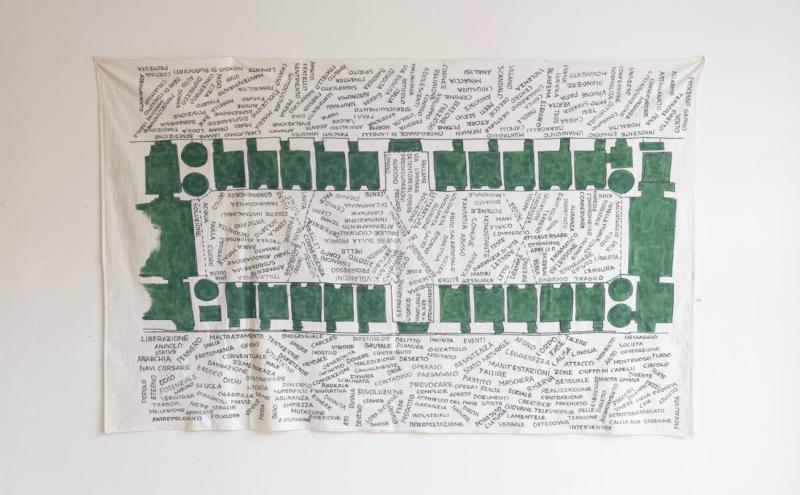
- Field work / carcere minorile Rom
- 2001
- paint marker and acrylic on cotton fabric
- 140 × 206 cm
Lois Weinberger’s “Field Work / Carcere Minorile, Rome” turns to Pier Paolo Pasolini’s “Corsair Writings” here in a reflection on social marginality, exclusion, and the overlooked spaces of contemporary society. Realized on the grounds of a former juvenile prison in Rome, Weinberger’s work expands upon his long-standing interest in ruderal plants, peripheral areas, and forms of life that emerge beyond institutional control. Drawing conceptually on Pasolini’s critique of modernization and cultural homogenization, Weinberger turns his own gaze to what survives at the edges: weeds, abandoned grounds, and those individuals pushed outside of dominant social structures.
Rather than presenting nature as a decorative element, Weinberger treats vegetation as a political and cultural agent. Plants become metaphors for resistance, migration, and the capacity to inhabit neglected environments. In the setting of a prison, this perspective takes on a special degree of resonance—suggesting alternative forms of freedom and transformation within spaces defined by regulation and confinement. The work creates a dialogue between ecological processes and social realities, echoing Pasolini’s concern for marginalized lives while proposing a poetic vision of persistence, renewal, and silent dissent. W.S.
Rather than presenting nature as a decorative element, Weinberger treats vegetation as a political and cultural agent. Plants become metaphors for resistance, migration, and the capacity to inhabit neglected environments. In the setting of a prison, this perspective takes on a special degree of resonance—suggesting alternative forms of freedom and transformation within spaces defined by regulation and confinement. The work creates a dialogue between ecological processes and social realities, echoing Pasolini’s concern for marginalized lives while proposing a poetic vision of persistence, renewal, and silent dissent. W.S.