Josef Dabernig – Plenty of Nothing
/8
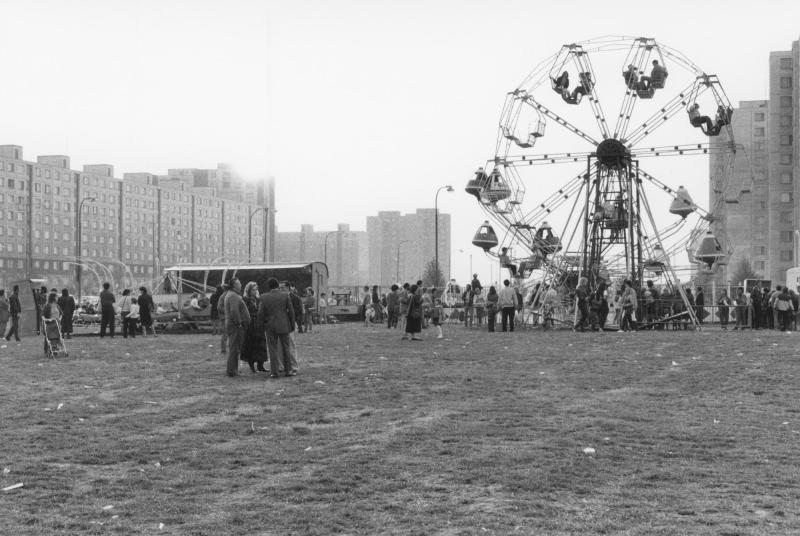
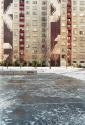
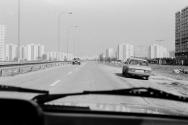
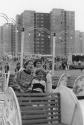
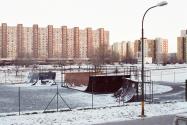
Just recently, Josef Dabernig authored a brief reflection on his art’s trajectory entitled “Melodramatic Film Miniatures as a Blueprint for Dematerialized Sculpture.” He starts out there by describing how he began working with steel and aluminum before gradually shifting toward the application of his existing conceptual mindset to serial photography and then film. This wryly humorous text serves as a reminder of how his filmmaking, the artistic endeavor most commonly associated with his name today, is rooted not in the culture of moving images but in sculpture. And indeed: upon seeing earlier works by Dabernig such as his aluminum profiles in their solitary, angular sleekness, their similarities to his films feel obvious—especially in terms of the two spheres’ shared minimalist sense, inner rhythm, and deep devotion to modernism’s more austere aspects. One might call this comparison superficial, but the surface is precisely Dabernig’s realm. While his cinema may be full of enigmatic gestures and difficult-to-decode rites, what matters is not their “true” meanings but simply how they look and manifest in the world, the patterns they create: choreographies of social rituals; remains of cultures past but still somehow present, haunting the now. As such, they tend to be at once melancholic and droll depending on how one views them.
Take his first solo effort, “Wisla” (1996)—deliberately without an “ł” in the title! This “anti-soccer miniature,” as Dabernig terms it, became an instant cult hit among soccer fans who recognized something essential about the sport they love in the absurdity of its useless hand gestures, dominant poses on the sidelines, and shallowest of gamesmanship displays—all performed in an empty, run-down stadium reverberating with disembodied chants and boos. (Non-soccer fans reportedly read these proceedings more allegorically, e.g., as would curators searching for some lost exhibition.) This absurd cycle of rites, rites of a “honcho-dom” that’s obsolete but still very much around, feels as if it were all that’s left—on top-flight pitches as well as in the corridors, offices, and back rooms of those conglomerates that turn Saturday’s passion play into coin by the billion.
In this same spirit of “melodramedy,” a football stadium can look like a space station (“Jogging,” 2000), hotel grounds can stand in for a far-off planet (“Zlaté Piesky Rocket Launch,” 2015), an erstwhile holiday retreat for Soviet cinematographers can become the collective image of tomorrow’s artist residencies (“Hypercrisis,” 2011), and the sacristy of a disused castle chapel can come to mirror an art collection with a gonfanon doubling as the building’s long-lost ghost or spirit (“Gertrud & Tiederich,” 2018).
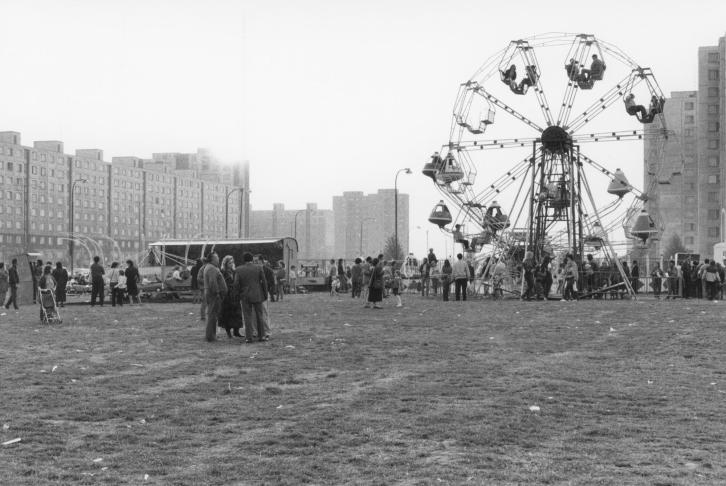
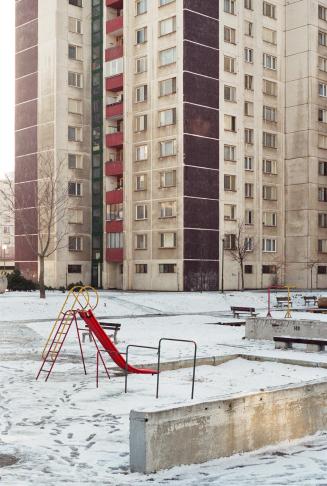
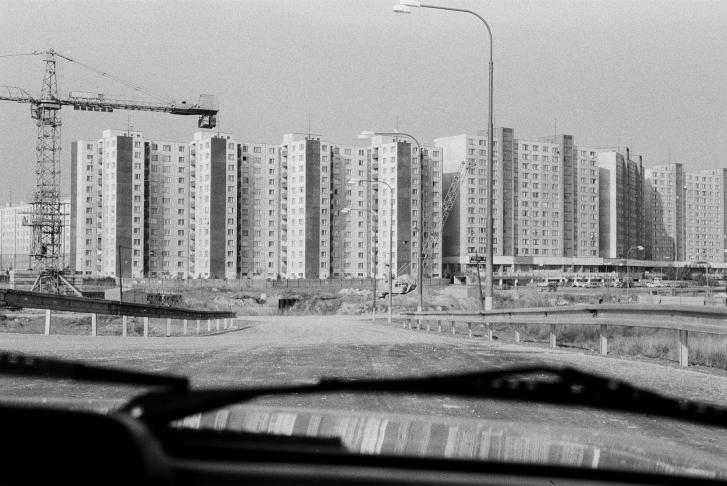
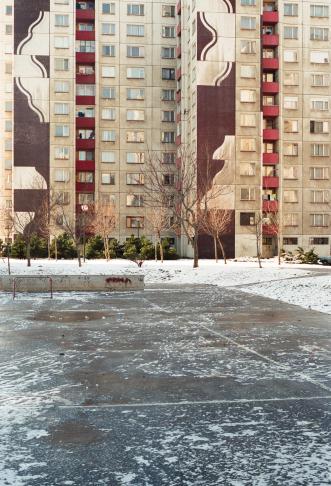
Soccer plays a big role in the films of this lifelong Udinese Calcio tifoso; as do derelict 20th-century buildings oozing postwar promise; as does the swath of Central and Eastern Europe in which Dabernig has shot a good part of his works, with only Italy possessed of similar importance for his imagination. If one considers his place of birth—the small Carinthian town of Kötschach-Mauthen, close to the Italian border and not that much farther from the border with Slovenia—one will immediately understand this focus: it is part of his sense of home, proximate and familiar yet somewhere else and deeply different, maybe even a bit uncanny. It’s likewise fitting that his filmmaking has acquired an increasingly private character as the years have gone by, especially in “Aquarena” (2007; together with Isabella Hollauf) and “Hotel Roccalba” (2008), followed by “River Plate” (2013), “All the Stops” (2020), and “Lacrimosa” (2024): these films feature several generations of Dabernigs and friends, some of whom act out variations on past rituals from real life. There is a family constellation-like aspect to these works, if clearly in jest: the Dabernig clan is, after all, just one big family like millions of others. In this light, there is something soothing to the silliness of repairing a bike in the blistering heat and other such things done with an endearing, easily recognizable obsessiveness. And it’s for this reason that “Pastry Friday” (2022) might just be the most sweet-natured work created by this fan of Austria’s coffee and pastry shop chain Aïda: seemingly unrelated (but, in reality, deeply related) people cross paths in a place of this general type to enjoy their piece of cake.
A special position in Dabernig’s filmic œuvre is claimed by the four works featuring texts by Bruno Pellandini, “Rosa coeli” (2003), “Herna” (2010), “Stabat Mater” (2016), and “Lacrimosa” (2024). These are his only works to use language in a narrative fashion; in “Gertrud & Tiederich” Dabernig merely recites an art collection’s inventory, while it is the text of Leipzig’s water ordinance that wafts through “Aquarena.” All others are devoid of words, though decidedly not silent—and while Dabernig never shoots with synch sound, everything audible is carefully composed. His film’s artificial soundscapes lend the goings-on something slightly unreal. The way in which Dabernig and Pellandini work together bears a vague resemblance to the collaborations of John Cage and Merce Cunningham, with one clear difference: Dabernig knows Pellandini’s texts when he starts shooting. But by virtue of how the texts flow alongside the moving images, with the two stories never touching, the visual content invites the viewer to discover variations, mutations, and transfigurations of Pellandini’s characters in Dabernig’s arrangements and choreographies.
Olaf Möller
Olaf Möller is a freelance writer and programmer based in Cologne and Helsinki. He is a critic for various international film magazines, a member of the IFFR selection committee and a consultant for several film festivals. He is an adjunct Professor of Film History and Theory at the School of Arts, Design and Architecture of Aalto University, and has co-written and published a variety of books on cinema.
https://www.filmmuseum.at/kinoprogramm/schiene?schienen_id=1781905830177
https://www.kontakt-collection.org/people/18/josef-dabernig/objects
October 2026
Take his first solo effort, “Wisla” (1996)—deliberately without an “ł” in the title! This “anti-soccer miniature,” as Dabernig terms it, became an instant cult hit among soccer fans who recognized something essential about the sport they love in the absurdity of its useless hand gestures, dominant poses on the sidelines, and shallowest of gamesmanship displays—all performed in an empty, run-down stadium reverberating with disembodied chants and boos. (Non-soccer fans reportedly read these proceedings more allegorically, e.g., as would curators searching for some lost exhibition.) This absurd cycle of rites, rites of a “honcho-dom” that’s obsolete but still very much around, feels as if it were all that’s left—on top-flight pitches as well as in the corridors, offices, and back rooms of those conglomerates that turn Saturday’s passion play into coin by the billion.
In this same spirit of “melodramedy,” a football stadium can look like a space station (“Jogging,” 2000), hotel grounds can stand in for a far-off planet (“Zlaté Piesky Rocket Launch,” 2015), an erstwhile holiday retreat for Soviet cinematographers can become the collective image of tomorrow’s artist residencies (“Hypercrisis,” 2011), and the sacristy of a disused castle chapel can come to mirror an art collection with a gonfanon doubling as the building’s long-lost ghost or spirit (“Gertrud & Tiederich,” 2018).
Soccer plays a big role in the films of this lifelong Udinese Calcio tifoso; as do derelict 20th-century buildings oozing postwar promise; as does the swath of Central and Eastern Europe in which Dabernig has shot a good part of his works, with only Italy possessed of similar importance for his imagination. If one considers his place of birth—the small Carinthian town of Kötschach-Mauthen, close to the Italian border and not that much farther from the border with Slovenia—one will immediately understand this focus: it is part of his sense of home, proximate and familiar yet somewhere else and deeply different, maybe even a bit uncanny. It’s likewise fitting that his filmmaking has acquired an increasingly private character as the years have gone by, especially in “Aquarena” (2007; together with Isabella Hollauf) and “Hotel Roccalba” (2008), followed by “River Plate” (2013), “All the Stops” (2020), and “Lacrimosa” (2024): these films feature several generations of Dabernigs and friends, some of whom act out variations on past rituals from real life. There is a family constellation-like aspect to these works, if clearly in jest: the Dabernig clan is, after all, just one big family like millions of others. In this light, there is something soothing to the silliness of repairing a bike in the blistering heat and other such things done with an endearing, easily recognizable obsessiveness. And it’s for this reason that “Pastry Friday” (2022) might just be the most sweet-natured work created by this fan of Austria’s coffee and pastry shop chain Aïda: seemingly unrelated (but, in reality, deeply related) people cross paths in a place of this general type to enjoy their piece of cake.
A special position in Dabernig’s filmic œuvre is claimed by the four works featuring texts by Bruno Pellandini, “Rosa coeli” (2003), “Herna” (2010), “Stabat Mater” (2016), and “Lacrimosa” (2024). These are his only works to use language in a narrative fashion; in “Gertrud & Tiederich” Dabernig merely recites an art collection’s inventory, while it is the text of Leipzig’s water ordinance that wafts through “Aquarena.” All others are devoid of words, though decidedly not silent—and while Dabernig never shoots with synch sound, everything audible is carefully composed. His film’s artificial soundscapes lend the goings-on something slightly unreal. The way in which Dabernig and Pellandini work together bears a vague resemblance to the collaborations of John Cage and Merce Cunningham, with one clear difference: Dabernig knows Pellandini’s texts when he starts shooting. But by virtue of how the texts flow alongside the moving images, with the two stories never touching, the visual content invites the viewer to discover variations, mutations, and transfigurations of Pellandini’s characters in Dabernig’s arrangements and choreographies.
Olaf Möller
Olaf Möller is a freelance writer and programmer based in Cologne and Helsinki. He is a critic for various international film magazines, a member of the IFFR selection committee and a consultant for several film festivals. He is an adjunct Professor of Film History and Theory at the School of Arts, Design and Architecture of Aalto University, and has co-written and published a variety of books on cinema.
https://www.filmmuseum.at/kinoprogramm/schiene?schienen_id=1781905830177
https://www.kontakt-collection.org/people/18/josef-dabernig/objects
October 2026